
Thin Footplate Kerrison Rongeurs and Curved Kerrisons for Spine Surgery
When the space under the lamina is tight, every tenth of a millimeter counts. A thinner footplate slides in with less pressure on the dura and the nerve root, which is why so many surgeons reach for a thin footplate Kerrison rongeur in the cervical spine. And when you need to work around a corner, in the foramen or the lateral recess, a curved Kerrison gets you there without fighting the anatomy.
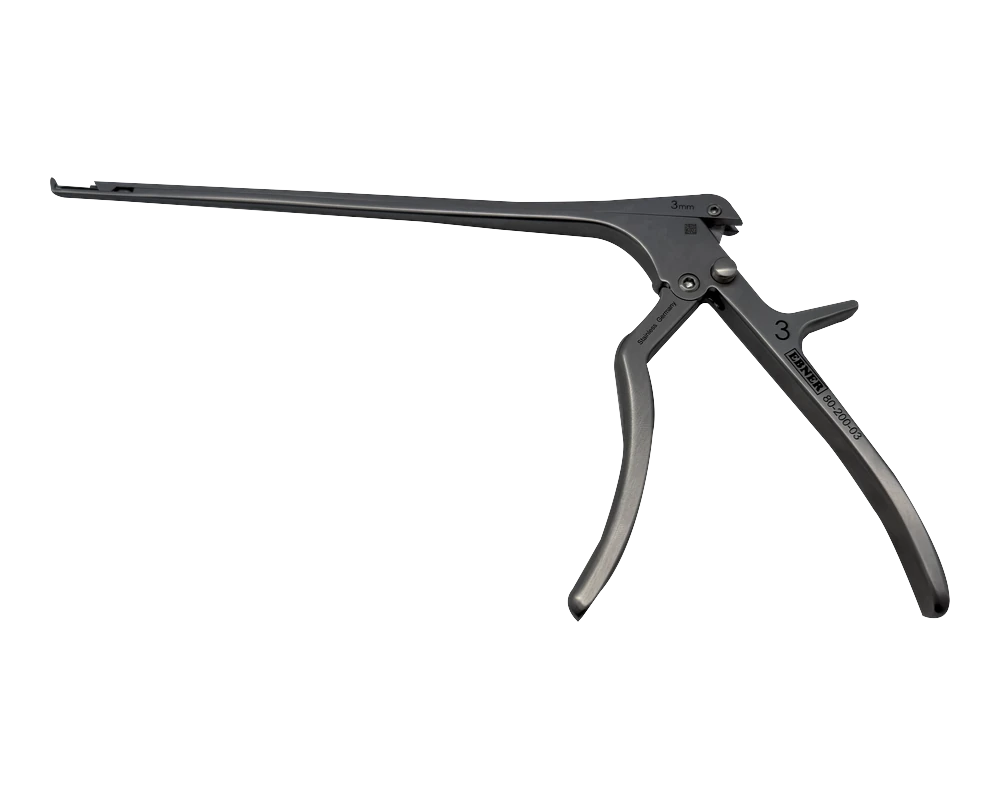
Three footplates to choose from
Wiggins Medical offers Kerrison rongeurs with standard, thin and ultra thin footplates. Our ultra thin footplate starts at just 1.3 mm on a 1 mm jaw, compared with 2.1 mm for a standard footplate of the same width. If you are choosing a thin footplate Kerrison rongeur for the first time, the table below shows exactly how much room each option saves.
| Footplate | Jaw width | Footplate thickness |
|---|---|---|
| Standard | 1 mm | 2.1 mm +/- 0.1 mm |
| Standard | 2 mm | 2.3 mm +/- 0.1 mm |
| Standard | 2.5 mm | 2.5 mm +/- 0.1 mm |
| Standard | 3 mm | 2.6 mm +/- 0.1 mm |
| Standard | 3.5 mm | 2.7 mm +/- 0.1 mm |
| Standard | 4 mm | 2.8 mm +/- 0.1 mm |
| Standard | 5 mm | 3.0 mm +/- 0.1 mm |
| Standard | 6 mm | 3.3 mm +/- 0.1 mm |
| Thin | 1 mm | 1.7 mm +/- 0.1 mm |
| Thin | 2 mm | 1.8 mm +/- 0.1 mm |
| Thin | 2.5 mm | 1.9 mm +/- 0.1 mm |
| Thin | 3 mm | 2.0 mm +/- 0.1 mm |
| Thin | 4 mm | 2.2 mm +/- 0.1 mm |
| Thin | 5 mm | 2.4 mm +/- 0.1 mm |
| Ultra thin | 1 mm | 1.3 mm +/- 0.1 mm |
| Ultra thin | 2 mm | 1.5 mm +/- 0.1 mm |
| Ultra thin | 3 mm | 1.6 mm +/- 0.1 mm |
| Ultra thin | 4 mm | 1.8 mm +/- 0.1 mm |
| Ultra thin | 5 mm | 2.0 mm +/- 0.1 mm |
Thickness is measured at the lower end of the cut, at a 90 degree angle toward the cut. Some sizes are made on demand, with lead times of up to 16 weeks. Call us and we will tell you what is on the shelf.
When to choose a thin or ultra thin footplate
A standard footplate gives you the most strength for heavy bone work, like lumbar laminectomy. A thin footplate Kerrison rongeur is a good everyday choice when you want a little more room without giving up much strength. The ultra thin footplate is built for the tightest spaces, such as cervical spinal stenosis, foraminotomy and revision cases, where getting under the bone with as little pressure as possible matters most.

Curved Kerrison styles
Our curved Kerrisons are shaped to follow the anatomy when a straight shaft won’t reach. Take a look at our Curved Foraminotomy Kerrison for foraminal work, and our Bayonet Kerrison when you are working through the microscope or a tubular retractor and need to keep your hands out of the line of sight. You can compare every style on our Kerrison Styles page.

Keeping your Kerrisons sharp
A sharp thin footplate Kerrison rongeur should take a clean bite and release it without tearing or dragging. If it starts to crush instead of cut, or the spring feels weak, it is time to send it home to us. Every Wiggins instrument carries a limited lifetime warranty when the repairs are done by Wiggins Medical, so there is no reason to keep fighting a tired instrument. See our warranty terms.
Frequently Asked Questions
How thin is an ultra thin footplate Kerrison?
Our ultra thin footplates measure 1.3 mm on a 1 mm jaw up to 2.0 mm on a 5 mm jaw, plus or minus 0.1 mm.
Which Kerrison is best for the cervical spine?
Many surgeons prefer a thin footplate Kerrison rongeur, or an ultra thin one, in the cervical spine because it takes up less room under the lamina. Give us a call and we can send a thin footplate Kerrison rongeur for you to try.
Order a catalog or contact us to request an evaluation.